







NPERA

Click the button to submit external correspondence

Click the button to submit external correspondence

Welcome to Nigerian Ports Economic Regulatory Agency
The Nigerian Ports Economic Regulatory Agency is the port economic regulator in the Marine and Blue Economy sector. Our primary responsibility is to facilitate trade and to protect the interests of Nigerian Shippers by promoting fair trade practices and ensuring service providers comply with approved standard operating procedures.
The Reviewed Port Concession Agreements
The Nigerian Ports Economic Regulatory Agency (NPERA) has successfully entrenched economic regulation in the reviewed seaport terminal Concession Agreements. NPERA is now formally recognised in the Concession Agreements as the Port Economic Regulator. This should end the resistance from some port stakeholders and private operators to the Agency carrying out its statutory mandate. In the past, that resistance seriously hampered the implementation of the port economic regulatory regime.
Promote the Digitalization and Automation of all Port Processes
NPERA is promoting the digitalisation and automation of all port processes in Nigeria. The goal is to cut costs, reduce human contact with cargo and do away with manual documentation, so that services are delivered more efficiently. The processes being digitalised include cargo release and manifest submission. Most regulated service providers are already fully digitalised.
Guidelines On Setting And Modification Of Tariffs, Rates And Charges For Service Providers In The Nigerian Port Sector
NPERA received requests from shipping lines and seaport terminal operators for a review of tariffs, rates and charges, since none had been reviewed in over ten (10) years. The Agency then assessed the requests in line with the Guidelines for Tariffs, Rates and Charges. The Honourable Minister of Marine and Blue Economy approved the review.
Click to view Guidelines
Implementation of International Cargo Tracking Note (ICTN)
On the 15th February, 2023, the Federal Executive Council (FEC) approved the reintroduction of the ICTN in Nigeria.
Lead Agency in the implementation of Nigerian Port Process Manual (NPPM)
As the Lead Agency for implementing the Nigerian Port Process Manual (NPPM), NPERA supervises the activities of the Port Standing Task Team (PSTT). The team's work focuses on three core areas: joint boarding and rummaging of vessels, joint cargo examination, and Operation Free the Port Corridors. Between 2021 and 2022, these efforts saved the Nigerian economy an average of $20,000 per day in vessel demurrage, a total of $12,350,000, which is over ₦5.4 billion.
Handling and Resolution of Complaints
NPERA handles a range of issues and complaints from stakeholders. These include arbitrary general increases in charges, punitive increases in container deposit rates, refusal or delay in refunding container deposits, and unnecessary delays in receiving returned empty containers, which leave shippers with costs they should not have to bear. The Agency also handles cases where consignees or agents refuse to pay demurrage or charges for services rendered, and cases where unfair terms are imposed on consignees and agents after shipment.
Facilitation of Vehicle Transit Areas (VTA)
NPERA is facilitating the development of Vehicle Transit Areas (VTAs), an important part of Nigeria's road transport infrastructure. A VTA is a public rest area located off the highway where truck drivers can stop and rest temporarily. Its facilities include a gas station, motel, restaurant, mechanic workshop, fire station, police post, automated cargo tracking system and banks, among others. The Agency has made significant progress in promoting two VTAs, one at Lokoja, Kogi State, and the other at Obollo Afor, Enugu State.
Border Information Centres (BICs)
The Border Information Centre (BIC) gives cross-border traders the information they need for seamless trade. It also helps bring informal cross-border trade into the formal economy and stops the revenue leakages that come with it.
read more
Confirmation of Reasonableness of Freight, Demurrage Fees and Charter Party Fees
To curb illegal capital flight, NPERA confirms on behalf of the Central Bank of Nigeria (CBN) that freight, demurrage and charter party fees are reasonable.
Facing Bottlenecks at the Ports? Lodge Your Complaint Today.
The Port Service Support Portal (PSSP) is your dedicated channel for swift resolution of operational delays, arbitrary charges, and service bottlenecks.
Visit PSSP

Latest News Update

Nigerian Ports Economic Regulatory Agency

The Agency promotes efficiency and competitiveness in Nigeria’s port sector through economic regulation, tariff oversight, monitoring of service standards, fair competition and protection of port users’ interests. These efforts promote transparency, reduce the cost of doing business, facilitate trade and support sustainable national economic growth.

MANDATE

Establish an Enabling Environment for all Stakeholders by instituting an Efficient and Effective Economic Regulatory System in the Transport Sector

VISION

To be the foremost port Economic Regulatory Agency driving Global Excellence for a sustainable Marine and Blue Economy.

MISSION STATEMENTS

To provide world-class regulatory oversight by leveraging advanced technology, rigorous monitoring and proactive stakeholder engagement through an environment driven by efficiency, innovation and sustainable growth in Nigeria’s maritime sector.

CORE VALUES

P– Professionalism

I-Integrity

V-Versatility

O – Opportunity Creation

T– Technology

Set, Monitor and enforce standards of service delivery, ensure stability, accessibility and adequacy of services.

Monitoring freight rates along the Nation’s trading routes and providing accurate and timely data and other vital information for Shippers.

Monitoring and advising on the general trends in both domestic and international commodity markets for the benefit of relevant stakeholders.

Negotiates and agrees with service providers on the quality of services and charges payable in accordance with local and international standards.

Disseminate trade and transport information to stakeholders through indicative freight rates and local shipping charges.

Providing training and educational resources to enhance knowledge and professionalism both in local and international trade.

Nsc

Who We Are

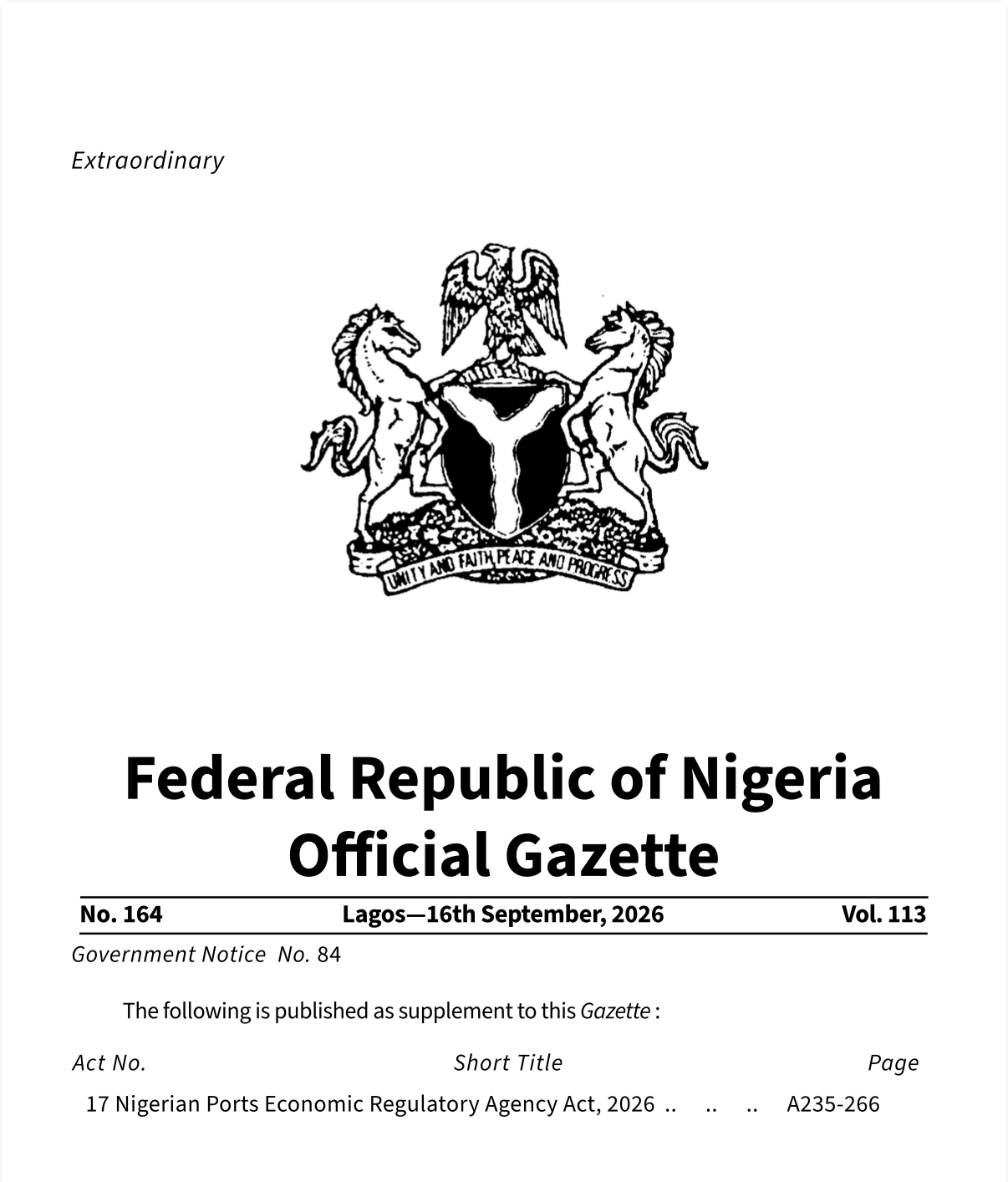
In line with the Federal Government’s port reform agenda, President Bola Ahmed Tinubu signed the Nigerian Ports Economic Regulatory Agency (NPERA) Act, 2026 into law. The Act repealed the Nigerian Shippers’ Council Act and turned the Council into NPERA, the statutory economic regulator of Nigeria’s ports. The Council had served as the interim Port Economic Regulator since 2014. NPERA’s mandate is to run an effective regulatory regime at Nigerian ports covering tariffs, rates, charges and other economic services. Before a dedicated economic regulator existed, port concession activities had a negative effect on the economy. NPERA works to address that effect so the country gets the full benefit of the Federal Government’s port reforms.

Youtube Feeds

Facebook Feeds

Shippers Feeds

“To reach a port, we must set sail — Sail, not tie at anchor — Sail, not drift.” — Franklin D. Roosevelt

PUBLIC NOTICE
APPLICABILITY: All Shipping Lines, Shipping Agencies, and Maritime Operators functioning within the Federal Republic of Nigeria. PREAMBLE & FINDINGS: WHEREAS the Nigerian Shippers' Council is statutorily mandated to promote efficiency, transparency, and customer-oriented service delivery within the Nigerian shipping industry and port sector. NOTING persistent infractions characterized by discourteous, dismissive, and unethical communication from shipping companies to consignees, agents, and port users concerning critical operational milestones, including cargo arrivals, export cargo evacuation, and operational approvals. NOTING FURTHER the unlawful and dilatory practice wherein shipping companies withhold operational approvals or decisions under the pretext of awaiting instructions or authorization from foreign parent companies or principals.